TL;DR
To be cited by AI search engines like ChatGPT, Perplexity, Claude, Gemini, and Google AI Overviews, your website needs to optimize for seven distinct signals: entity completeness, schema markup, authority signals, content quotability, topical depth, technical foundations, and freshness. Traditional SEO is no longer enough. The businesses that adapt to Generative Engine Optimization (GEO) in 2026 will hold a durable advantage over those that wait.
The Rules of Search Just Changed
For twenty years, the goal of search engine optimization was simple: rank on Google's first page, ideally in the top three. Get the click. Get the customer. Most local businesses still treat SEO this way in 2026.
But that's not how customers find businesses anymore.
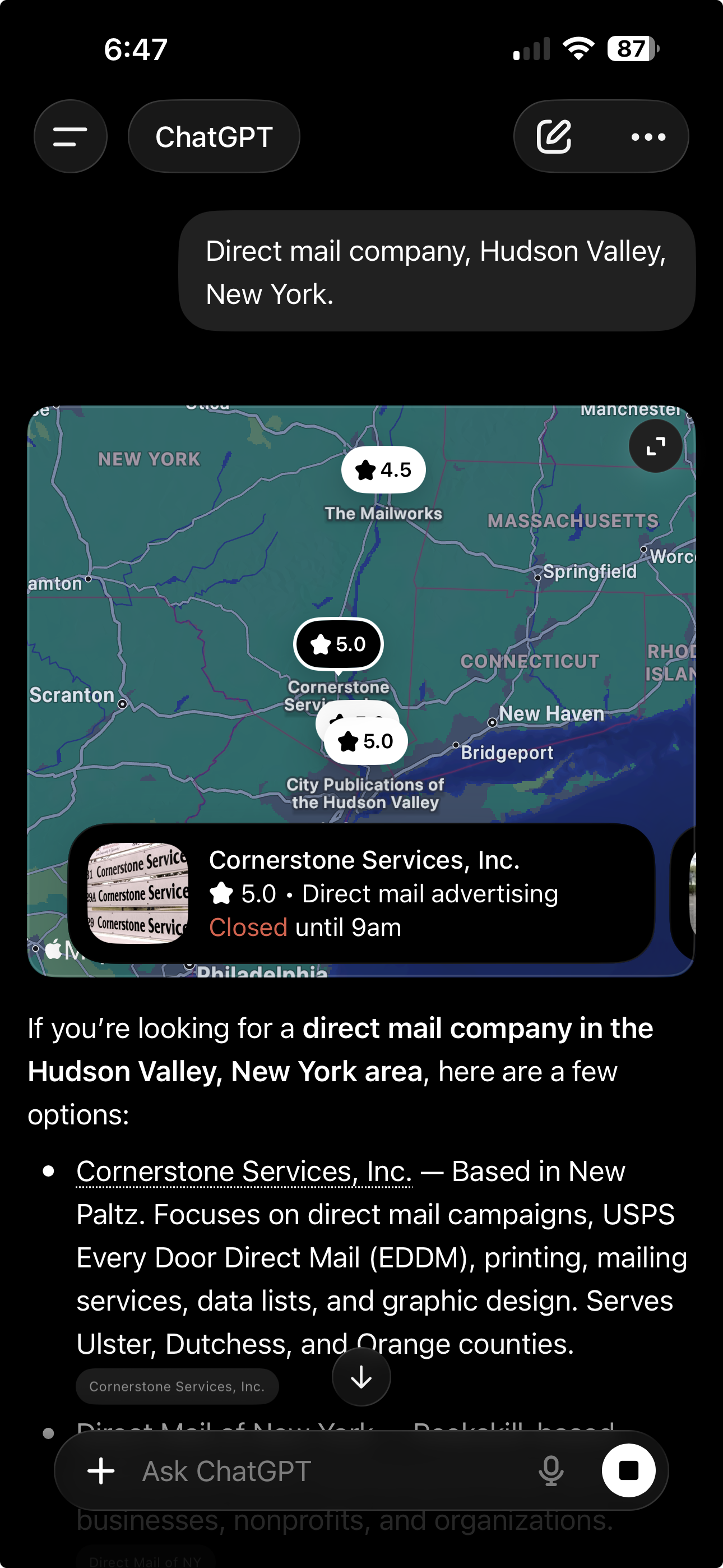
When someone asks ChatGPT for "the best independent insurance agent in the Mohawk Valley," they don't get ten blue links. They get a generated answer with one, maybe two businesses cited. When someone Googles "tree removal Hudson Valley," they see Google's AI Overview at the top of the page before they ever scroll to the traditional results. When researchers use Perplexity, Claude, or Gemini to find a service provider, the AI surfaces a curated answer pulled from a small number of authoritative sources.
The "ten blue links" world is becoming the "one cited answer" world.
"If your business isn't cited in the answer, it doesn't exist."
This article is for local business owners, marketing managers, and SEO operators who want to understand how AI search actually works in 2026 — and what specifically your website needs to be cited by ChatGPT, Perplexity, Google AI Overviews, and the other generative search engines now driving an increasingly large share of customer discovery.
I'm Bryan Collins. I've spent thirty years in IT infrastructure and twenty years building websites and doing SEO. Today I build authority sites for local businesses, specifically engineered to be cited by AI search engines. What follows is the framework I use with clients — what works, what doesn't, and where most local businesses (and most agencies) are still getting it wrong.
What Is GEO (Generative Engine Optimization)?
Generative Engine Optimization, or GEO, is the practice of optimizing a website so that AI search engines will cite that website as a source when answering user questions.
GEO is not the same as traditional SEO. Traditional SEO is about ranking pages in a list of results. GEO is about being one of the small number of sources an AI engine chooses to quote, cite, or reference when generating an answer to a user query.
The two practices overlap significantly. A site that's well-optimized for traditional SEO is usually a stronger candidate for AI citation. But they're not identical, and treating them as the same is one of the most common mistakes I see local businesses make.
The shift matters because AI engines don't just rank — they decide. Where traditional search showed users a list of options and let them pick, AI search picks for them and shows them the answer. The decision now happens inside the AI engine, not in the user's head. Your job as a business is to influence that decision.
How AI Search Engines Decide Who to Cite
To get cited by AI, you need to understand — at least at a high level — how these systems actually work.
Modern AI search engines use a process called Retrieval-Augmented Generation (RAG). When a user asks a question, the system:
- Retrieves a set of candidate sources from an index of web content
- Ranks those sources based on relevance, authority, and quality signals
- Generates an answer that quotes, paraphrases, or cites the top-ranked sources
The retrieval step is where most local businesses lose. If your site doesn't make it into the candidate set in the first place, none of your other optimization work matters. You're invisible from the start.
Once you're in the candidate set, the ranking and citation step is where authority, schema, and content quality decide whether you're the one quoted, or whether your competitor is.
Different AI engines weight these factors differently:
- Google AI Overviews lean heavily on existing Google ranking signals — sites that already rank well in traditional Google results are heavily favored as citation sources.
- ChatGPT (when using web search) prioritizes well-structured, fact-dense content and authoritative domains. It frequently cites Reddit, Wikipedia, and editorial publications.
- Perplexity is unusually transparent about its sources and tends to favor recent, specific, and well-cited content. It will sometimes cite smaller, deeply focused sites that other engines miss.
- Claude and Gemini each have their own weighting algorithms, but the underlying principles are broadly similar.
The good news: optimize for the underlying signals, and you tend to do well across all of them.
The Seven Signals That Get Your Business Cited
After two years of building sites for clients with AI citation as an explicit goal, I've narrowed the work down to seven signals that consistently matter. None of these are secret. All of them require real work. Most local business sites fail on most of them.
1. Entity Completeness
Is your business a recognized entity in the AI's knowledge graph?
AI search engines maintain internal representations of real-world entities — businesses, people, places, concepts. When a user asks about your industry, the AI consults its entity graph to identify candidate businesses. If your business isn't in the graph, or is represented incompletely, you don't make the candidate set.
Entity completeness signals include:
- A Wikipedia article (where applicable and warranted by notability standards)
- A Wikidata entry with structured properties
- A Google Knowledge Panel
- Consistent NAP (name, address, phone) data across every directory and platform where you appear
- Verified social media presence on platforms relevant to your industry
- Listings in authoritative industry directories
Most local businesses have weak entity signals. Their NAP varies across directories. They don't have a Knowledge Panel. They've never been entered into Wikidata. Fixing these things isn't fast, but it's foundational. Without entity completeness, every other optimization is fighting uphill.
2. Schema Markup That AI Can Parse
Schema markup is structured data that tells search engines what your content actually means. It's how AI engines read your site at machine speed.
The schema types that matter most for local businesses include:
- LocalBusiness — and where applicable, a more specific subtype like AutoRepair, InsuranceAgency, Restaurant, or HomeAndConstructionBusiness
- Organization — for the parent entity
- FAQPage — for question-and-answer content (this is gold for AI citation)
- BreadcrumbList — for navigation hierarchy
- Service — for individual service offerings
- Review and AggregateRating — where you have legitimate reviews
- Person — for the business owner or key staff, to build personal entity signals tied to the business
Schema isn't optional anymore. If you don't have it, you're invisible to the layer of search that reads your site programmatically. Validate everything with Google's Rich Results Test.
3. Authority Signals Beyond Backlinks
Backlinks still matter. But in the AI search era, who's mentioning you matters more than how many links you have.
A single mention in a respected industry publication — your local newspaper, an industry trade journal, a partner organization's site — does more for AI citation than fifty links from generic directories or low-quality content farms.
AI engines look at brand mention frequency and the authority of the sources doing the mentioning. Build relationships with:
- Local news outlets and journalists
- Industry trade publications
- Adjacent service providers in your area
- Local business associations and chambers
- Real partners, suppliers, and clients willing to feature you
Brand mentions without links still count. AI engines parse text for entity references, and a mention of your business name in an authoritative article registers as a signal whether it's hyperlinked or not.
4. Content AI Can Actually Quote
AI engines extract quotable passages from web content to use in generated answers. Content that's structured for human reading often isn't structured for AI extraction.
What makes content quotable:
- Direct, declarative sentences
- Specific facts and numbers
- Clear definitions of key terms near the top of the page
- Question-and-answer formats with FAQPage schema
- Fact-dense paragraphs that pack multiple verifiable facts
Write the way a textbook is written, not the way a casual blog post is written. Then add personality on top of that foundation.
5. Topical Depth, Not Topical Breadth
AI engines reward sites that demonstrate deep authority on a narrow topic over sites that spread thin across many topics.
A site with thirty pages on local plumbing in Brooklyn — covering different services, neighborhoods, plumbing problems, and frequently asked questions — will outperform a site with two hundred random pages spanning every home service category.
This is why I build authority sites for clients in specific verticals. Twenty to thirty pages of deep, focused content on a single market beats a generic, broad site every time. Pick your topical core, go deep, and let other topics be other sites' problem.
6. Technical Foundations
AI engines don't cite slow, broken, or inaccessible sites. The basics still matter:
- Mobile-responsive design that actually works
- Fast page load times — Core Web Vitals in the green
- HTTPS / SSL certificates correctly configured
- Clean URL structures with semantic paths
- Proper internal linking that creates topical hierarchy
- Accessibility — alt tags, semantic HTML, keyboard navigation, ARIA labels where needed
These won't get you cited by themselves. But missing any of them can disqualify you from the candidate set entirely. Technical foundations are table stakes, not differentiators.
7. Freshness and Active Maintenance
AI engines prefer recently updated content over abandoned content. A site that hasn't been touched in two years signals to AI engines that the business may not be active.
This doesn't mean blog daily. It means:
- Update your business information when it changes
- Refresh cornerstone pages annually
- Publish new content on a sustainable cadence (monthly is usually enough)
- Respond to reviews and showcase recent ones
- Keep your service offerings and team information current
A site that's clearly maintained earns trust signals across every AI engine.
What Most Local Businesses Are Missing
Here's the honest gap I see most often, in roughly the order I encounter it:
- Schema markup is incomplete, incorrect, or missing entirely
- The business isn't a recognized entity in AI knowledge graphs
- Content is written for humans only, not structured for machine parsing
- Backlinks come from low-quality directories, not from genuinely respected publications
- Topical authority is shallow — too many topics covered, none of them deep
- The site is slow, has accessibility issues, or doesn't render well on mobile
- The site hasn't been meaningfully updated in over a year
Most local business sites fail on four or more of these.
Agencies built around traditional SEO are still mostly optimizing for the old game. They're tracking keyword positions while their clients quietly disappear from AI Overviews. The shift caught them off guard. They're optimizing for a game whose rules are already changing under them.
That's the opportunity — for businesses that move now, before the gap closes.
A Step-by-Step Implementation Plan
If you want to position your business for AI citation, here's the order I recommend:
- Audit the current state. Before you change anything, document where you stand on the seven signals above. Most businesses skip this and waste time fixing things that aren't the actual bottleneck.
- Fix the technical foundations. Speed, mobile responsiveness, HTTPS, accessibility. These are table stakes. If your site fails on these, no amount of content or entity work will compensate.
- Implement complete schema markup. Get LocalBusiness, Organization, FAQPage, BreadcrumbList, and Service schema in place. Validate with Google's Rich Results Test. Fix any errors before moving on.
- Build entity completeness. Audit your NAP across every directory. Create or claim your Google Business Profile. Set up Wikidata if appropriate. Pursue a Knowledge Panel if you don't have one.
- Restructure existing content for AI extraction. Add FAQ sections with proper schema. Rewrite key paragraphs to be more quotable. Add definitions for the key terms in your space.
- Build authority signals. Get mentioned in real publications. Build relationships with local journalists and industry partners. Pursue quality citations and brand mentions, not just backlinks.
- Maintain and iterate. Update regularly. Monitor where your site is being cited (and where it's not). Adjust based on what's working. AI search is still evolving, and so should your approach.
This is months of work, not weeks. There are no shortcuts. Anyone selling you instant AI citation is lying.
What's Next for AI Search in 2026 and Beyond
AI search adoption is accelerating faster than most local businesses realize. Google's AI Overviews now appear on a substantial percentage of searches and are expanding across query categories. ChatGPT's web search is integrated into most user workflows. Perplexity has become a default for research-driven queries among professionals. New AI search engines are launching regularly, and the existing ones are getting more capable every quarter.
The signal-to-noise ratio for cited businesses is going to keep tightening. Today, being in the top ten for a local search is often enough to compete. In two years, only the top one or two cited sources will get meaningful visibility.
The businesses that invest in AI citation work now will have a durable advantage. The businesses that wait will spend years trying to catch up.
This isn't optional anymore. It's the new baseline.
Frequently Asked Questions
GEO is the practice of optimizing a website to be cited as a source by AI search engines like ChatGPT, Perplexity, Claude, Gemini, and Google AI Overviews. Unlike traditional SEO, which focuses on ranking pages in a list of results, GEO focuses on becoming one of the small number of sources an AI engine chooses to quote when generating an answer.
Traditional Google search returns a list of pages. AI search generates a direct answer with a small number of cited sources. The user sees one curated answer, not ten options. Visibility shifts from "ranking in the top ten" to "being one of the one to three cited sources."
Yes. Traditional SEO and GEO overlap significantly. Most signals that help your site rank in traditional Google also help your site get cited by AI. But GEO requires additional work — entity completeness, schema markup, content quotability, brand mentions — that traditional SEO sometimes overlooks.
Realistically, three to six months of consistent work on the seven signals above. Some signals (technical fixes, schema implementation) show results faster. Others (entity building, authority signals) take longer. Anyone promising instant AI citation is lying.
Yes — especially small local businesses. AI search disproportionately affects local discovery because customers increasingly ask AI engines for service provider recommendations directly. If your business isn't in the answer, you're invisible to that customer.
LocalBusiness (with the most specific subtype that applies to your industry), Organization, FAQPage, and Service are the four most important. BreadcrumbList helps for navigation hierarchy. Person schema is useful for personal entity signals tied to the business owner.
About the Author

Bryan Collins is a freelance SEO consultant and authority site builder based in Orange County, New York.
He spent thirty years in IT infrastructure, including twenty-five years running networks, systems, and technical operations for corporate offices and educational institutions. His infrastructure background covers routing and switching, wireless networks, desktop support, server management, and the technical foundations that keep businesses operating.
Bryan transitioned to full-time SEO and web development work in 2024. He specializes in building authority sites engineered for AI search citation using Astro and Tailwind CSS, deployed on modern developer-grade infrastructure. Recent client work includes independent insurance agencies, custom home builders, retail storefronts, forestry consulting firms, churches, and other local businesses across the Hudson Valley, Mohawk Valley, and Southern Tier of New York.