
I’m going to settle this in three sentences.
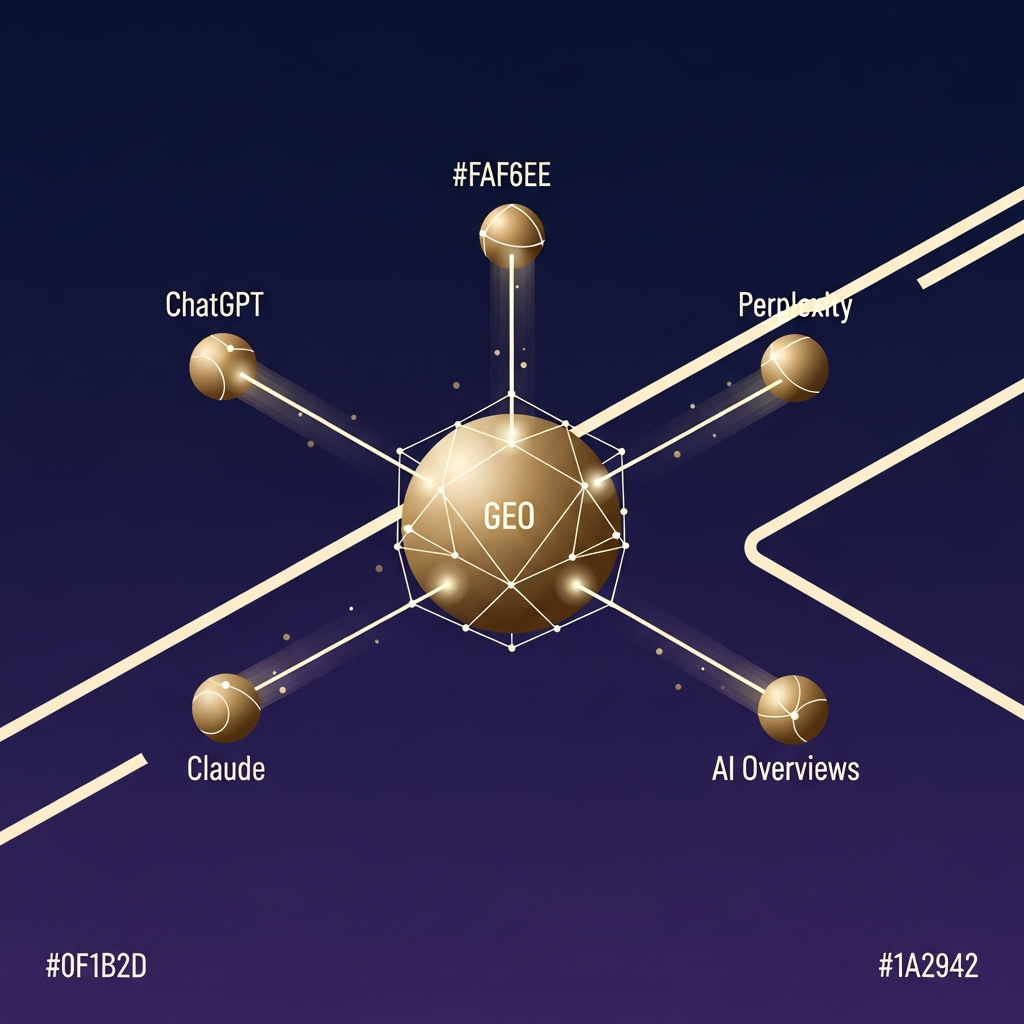
AEO (Answer Engine Optimization) and GEO (Generative Engine Optimization) describe essentially the same body of work — getting your site cited in AI-generated answers across ChatGPT, Perplexity, Claude, Google AI Overviews, and the rest. AEO came first as a term, popular through 2023 and early 2024. GEO is the term that’s winning the search volume contest, the practitioner adoption contest, and — most importantly — the term Google’s own documentation has started using.
If you’re reading this article because someone on LinkedIn is insisting one acronym is “correct” and the other is wrong, here’s the truth: both terms describe the same work. The differences are mostly framing and emphasis, not substance. But the term you choose has practical implications for how your content gets discovered and how clients find your services, so it’s worth picking one deliberately rather than using both interchangeably.
This guide explains where each term came from, what each one emphasizes, why GEO is overtaking AEO in 2026, and which one you should commit to using going forward. Roughly 2,200 words. The full background on what either acronym actually refers to lives in the complete 2026 GEO guide — that’s the pillar this piece supports.
The Short Answer
AEO and GEO describe the same body of work — optimizing content so AI engines cite it as a source. AEO (Answer Engine Optimization) came first and emphasized optimizing for answer-focused engines like Perplexity. GEO (Generative Engine Optimization) came later and emphasizes optimization for any generative AI engine. In 2026, GEO is the term that’s winning practitioner adoption and search volume, but the underlying work is essentially identical regardless of which term you use.
If you only need that, you’re done. Use GEO going forward. Stop arguing about the vocabulary.
If you want to understand why one term overtook the other, where each one came from, and what the practical differences are when you’re choosing between them — read on.
Where AEO Came From
Answer Engine Optimization first showed up as a term in late 2022, just after ChatGPT launched. The early use was specific: it referred to optimizing content for emerging “answer engines” — products like Perplexity that explicitly positioned themselves as alternatives to traditional search engines. The framing was “search engines return links, answer engines return answers.”
That framing made sense at the time. ChatGPT in late 2022 didn’t really do citations. Perplexity was building its entire product around the citation model. Google AI Overviews didn’t exist yet. The landscape had one product (Perplexity) doing something genuinely different from traditional search, and “Answer Engine Optimization” was a clean way to name the work of optimizing for it.
Through 2023, AEO got picked up by a small group of consultants and content marketers. Some early Substacks and Twitter threads built decent followings around the term. A few agencies rebranded around it. The work being described was real and the term was useful.
Then 2024 happened. Google launched AI Overviews and rolled them site-wide. ChatGPT added browsing and citations. Claude added search. Bing followed. Gemini caught up. Suddenly the “answer engine” framing didn’t fit anymore — these weren’t separate product categories. AI-generated answers became the dominant search experience across all major engines, not just at Perplexity.
That’s when GEO took over.
Where GEO Came From
Generative Engine Optimization started appearing as a term in mid-to-late 2024, after AI Overviews launched. The framing was different and ultimately better. Instead of distinguishing “search engines” from “answer engines,” GEO acknowledged that all the major engines had started generating answers — ChatGPT, Perplexity, Claude, Google AI Overviews, Gemini, Copilot. They weren’t different categories of product anymore. They were all generative AI engines, and the optimization work was largely the same across all of them.
The first academic paper to seriously use the term “Generative Engine Optimization” came out in late 2023, from a research group at Princeton. The paper studied how to engineer content to be more likely to be cited by generative engines, and proposed specific techniques (citation insertion, statistics addition, fluency improvements). The paper itself didn’t go mainstream, but it gave the term academic legitimacy that AEO never picked up.
By mid-2025, GEO had overtaken AEO in three measurable ways:
- Search volume. Google Trends shows “generative engine optimization” surpassing “answer engine optimization” in early 2025. By late 2025, GEO had roughly 3x the search volume of AEO.
- Conference talks and industry events. GEO became the term used at SMX, BrightonSEO, MozCon. AEO mostly disappeared from major event programming.
- Tool naming. New tools launching in 2025 mostly named themselves with GEO terminology. The AEO tools that existed mostly rebranded or expanded their vocabulary to include GEO.
By the time this article publishes in May 2026, GEO is the dominant term and AEO is treated as a legacy synonym — still understandable, still occasionally used, but no longer the default.
What Each Term Actually Emphasizes
This is where the substantive differences live, such as they are.
AEO emphasized the answer surface. The implicit question AEO asks is: how do I get cited in the answer? It frames the user journey as the user asking a question, the AI generating an answer, and citations being attached to that answer. The tactics that flow from AEO framing tend to focus on direct-answer blocks, FAQ structure, comparison tables, and question-matching keyword research. AEO writing tends to be tightly focused on extractability.
GEO emphasizes the engine. The implicit question GEO asks is: how do I get this AI engine to recognize me as a credible source? It frames the work as building authority signals (schema, entity recognition, E-E-A-T) that the engine evaluates before deciding what to surface. The tactics that flow from GEO framing tend to focus on topical depth, author identity, structured data, and cross-engine consistency. GEO writing tends to be broader in scope.
In practice, these emphases overlap by about ninety percent. A well-executed AEO strategy looks almost identical to a well-executed GEO strategy. The differences are at the margins — AEO tends to over-index on answer formatting and under-invest in entity work; GEO tends to over-index on broad authority signals and under-invest in tight extractability. The best practitioners do both.
If you want the full breakdown of how the work splits — what stayed the same from traditional SEO, what changed, and what’s genuinely new — I wrote the GEO vs SEO comparison as a separate piece. The vocabulary debate matters less than the actual work.
Why GEO Is Winning
A few reasons, in roughly the order of importance:
The category expanded. AEO was named when “answer engines” felt like a distinct product category. By 2026, every major search and chat product generates answers. The category framing in “Answer Engine Optimization” no longer matches the landscape. GEO’s broader framing — any generative engine — fits the current state of the market better.
Google’s documentation uses GEO. When Google started publishing best-practice content about how to appear in AI Overviews, they used GEO-adjacent language. That matters disproportionately. Google’s vocabulary tends to become the industry’s vocabulary within twelve to eighteen months, because that’s where SEO professionals look for canonical guidance.
Academic legitimacy. The Princeton paper gave GEO an academic foothold that AEO never developed. When journalists and analysts write about the field, they tend to cite the academic literature, which uses GEO terminology. AEO doesn’t have an equivalent.
Practitioner adoption. The most influential GEO writers in 2024-2025 — the ones whose newsletters and posts shaped the field — settled on GEO. Once that critical mass formed, AEO became the term used by people who hadn’t kept up. Vocabulary follows authority signals, just like everything else in this field.
The “answer engine” name was always slightly off. Even at the height of AEO usage, the term felt incomplete. “Answer engine” implied a binary: a tool that returns answers, in opposition to a search engine that returns links. But ChatGPT, Perplexity, and Claude have always also returned links. They’ve always been search products that generated additional content. “Generative engine” captures that more accurately.
What About AIO and LLM SEO?
While we’re here, let’s settle the other two acronyms that show up in this debate.
AIO (AI Overview Optimization) is the narrowest of the four terms. It refers specifically to optimizing for Google’s AI Overviews feature, not to the broader AI engine landscape. AIO can be a useful sub-term when you specifically mean “the Google AI Overview surface,” but using it as a synonym for GEO is misleading — Perplexity isn’t an AI Overview, and your AIO strategy won’t fully cover it.
LLM SEO is the most technical-sounding of the four. It emphasizes optimization for large language models specifically, with vocabulary borrowed from machine learning (tokenization, embedding, prompt-completion behavior). LLM SEO and GEO describe essentially the same work, with LLM SEO writers tending to focus more on the underlying model behavior and GEO writers tending to focus more on practical signal categories.
If you map all four terms onto a single grid:
| Term | Scope | Best Used When |
|---|---|---|
| AEO | Same as GEO (legacy) | You’re communicating with someone who hasn’t updated their vocabulary since 2023 |
| GEO | Broadest — all AI engines | Default for 2026 and going forward |
| AIO | Narrowest — Google AI Overviews only | When you specifically mean the Google surface |
| LLM SEO | Same as GEO with technical emphasis | Communicating with developer or ML audiences |
For most purposes, use GEO. Use AIO when you specifically mean Google. Use LLM SEO if you’re writing for technical audiences who’d find that framing more natural. Stop using AEO except as a parenthetical clarification when needed.
The Practical Implication of Picking a Term
You might be wondering why any of this matters. Three reasons:
Reason 1: Your content gets discovered by the term you use consistently. If you write about “generative engine optimization” repeatedly across your site, you build topical authority for that term. If you flip between AEO, GEO, AIO, and “AI search optimization” without consistency, you fragment your topical signal and the AI engines can’t decide which entity you’re trying to be associated with. Pick one term. Use it consistently. Note synonyms once per page and move on.
Reason 2: Client searches use one term, not three. A potential client searching for help typically uses one of these terms — usually whichever one they heard first. In 2026, that’s overwhelmingly “GEO.” Sites that use GEO as their primary term capture more of that search demand. Sites that use AEO or LLM SEO as their primary term capture less.
Reason 3: Internal communication gets easier. If your team uses one term consistently, your strategy documents, content briefs, and audits get clearer. If different team members use different terms for the same work, you’ll have endless low-stakes vocabulary debates that drain time and produce nothing.
The practical choice for anyone reading this in mid-2026 or later: commit to GEO as your primary term. Use AEO once per page as a synonym reference for searchers who still use that vocabulary, then move on.
A Quick Audit: Which Term Are You Currently Using?
Five-minute audit to check your own vocabulary consistency:
1. Open your About page. Which acronym appears, if any? If you mention AEO and not GEO, you’re behind the current vocabulary. If you mention both, you’re fragmenting your topical signal.
2. Search your own site. If your site has internal search, run “GEO” and “AEO” as queries. Count results. The ratio tells you which term you’re prioritizing whether you meant to or not.
3. Check your service page titles. If you offer GEO or AEO services, which term is in the page title? That term gets associated with your business in search results.
4. Look at your social bios. LinkedIn, Twitter, Medium. Which acronym appears in the descriptions? Inconsistency across platforms confuses the AI engines that are trying to associate your name with a topic.
5. Read your last five content pieces. Which acronym appears most? Did you use them interchangeably within the same piece?
If your audit comes back inconsistent, the fix is straightforward: pick GEO going forward, do a find-and-replace on the most important pages, and stop using AEO as a primary term. Use it once per page as a synonym mention if you want to capture the residual search demand, but don’t lead with it.
If you’d rather have someone run a comprehensive audit on your site — including vocabulary consistency, schema completeness, entity recognition, and the full SEE Framework — that’s the $49 AI Search Audit I deliver. Written report with specific recommendations.
Where to Go From Here
If the vocabulary debate has been distracting you from actual GEO work, here’s where to focus next:
- The Complete 2026 Guide to Generative Engine Optimization — the pillar. Covers what GEO actually is, the four citation signals, and the SEE Framework for auditing your own site.
- GEO vs SEO: What’s Actually Different in 2026 — the sibling article. Breaks down the 60% overlap, the 40% that’s new, and a 90-day transition plan.
- Best AI SEO Tools in 2026: An Honest Review — current tool landscape across the GEO/AEO/AIO space.
If you want a real GEO audit on your site rather than more theory, that’s the AI Search Audit — $49, written report, delivered within a week.
Frequently Asked Questions
Are AEO and GEO the same thing?
In practice, yes. Both terms describe the work of optimizing content so AI engines cite it as a source. AEO is the older term that came up in 2022-2023. GEO is the newer term that overtook AEO in 2025-2026. Some practitioners still use AEO out of habit, but the underlying work is identical.
Should I use AEO or GEO on my website?
Use GEO as your primary term in 2026 and going forward. It’s the term winning search volume, practitioner adoption, and industry vocabulary. You can mention AEO once per page as a synonym reference, but don’t lead with it.
What’s the difference between AEO and AIO?
AEO (Answer Engine Optimization) is a broad term covering all AI engines. AIO (AI Overview Optimization) is narrow — it refers specifically to Google’s AI Overviews feature. AIO is a subset of AEO, which is a subset of GEO. In practical use, AIO is the only one of the three that’s narrowly defined enough to mean something specific.
Is LLM SEO different from GEO?
LLM SEO and GEO describe the same body of work with different vocabulary. LLM SEO writers tend to focus more on technical details like tokenization, embedding patterns, and how language models process content. GEO writers tend to focus more on practical signal categories like schema, entity recognition, and topical depth. The recommendations are largely identical regardless of which term you use.
Who invented the term GEO?
The earliest serious academic use of “Generative Engine Optimization” came from a research group at Princeton in late 2023. The paper proposed specific techniques for making content more likely to be cited by generative AI engines. Practitioner adoption of the term grew significantly in 2024 after Google AI Overviews launched.
Did GEO replace AEO?
In terms of which term practitioners use, yes — GEO has largely replaced AEO in mainstream usage by 2026. In terms of the underlying work, neither replaced the other because they always described the same thing. The vocabulary shift is real; the work shift is not.
Will GEO eventually be replaced by another acronym?
Probably. This field invents new vocabulary roughly every twelve to eighteen months. Don’t optimize your strategy around the latest term — optimize it around the actual work (schema, entity, expertise, topical depth, freshness) which has been stable since AEO came up in 2022. The work is more durable than the vocabulary.

Bryan Collins runs CRST Web and bryancollinsonline.com. He's worked in digital infrastructure for thirty years and is the author of "Why Your Website Isn't Ringing: The Send Click Convert System for Local Businesses" (Amazon, 2025). He builds GEO-optimized authority sites using Astro and Tailwind CSS, delivers AI Search Audits for small and mid-sized businesses, and runs the Tradesman Stack SaaS at newtradeleads.com — all built on the GEO principles described in this guide.
Last updated: May 23, 2026. This page is refreshed quarterly as AI engine behavior evolves.