
If your organic traffic dropped between June 2024 and today, you weren’t penalized. You weren’t deindexed. Your content didn’t suddenly become worse.
What happened is simpler — and worse. The search box stopped sending you traffic, because the search box stopped being a search box.
When someone types a question into Google now, the answer appears at the top. ChatGPT and Perplexity do the same thing in their own boxes. The user reads the answer and closes the tab. Your blue link, even when it ranks at position #1, gets bypassed entirely.
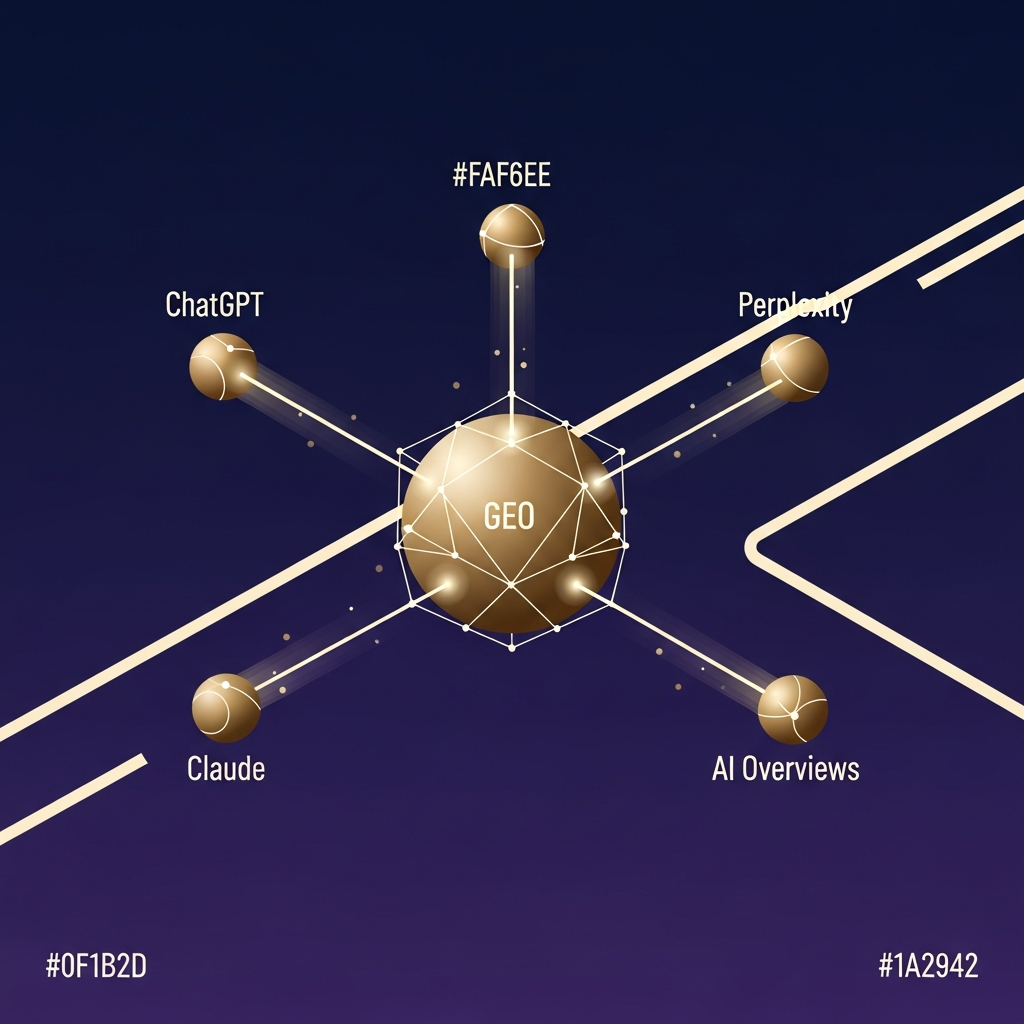
This is the problem generative engine optimization solves. The acronym is GEO. The work is different from traditional SEO in ways most agencies haven’t caught up to yet. I’ve spent the last eighteen months testing what gets cited and what doesn’t across the four engines that matter — ChatGPT, Perplexity, Claude, and Google AI Overviews — and I’m going to walk you through everything I’ve learned.
This guide covers what GEO is, how it differs from SEO, the four signals AI engines use to decide who to cite, the SEE Framework I use to audit sites, and what tools exist in this space right now. Roughly 5,000 words. Read it once, bookmark it, run the checklist.
40%+
AI citations come from factual comparison content
60%
Overlap between GEO and traditional SEO signals
2–6 wks
For schema fixes to appear in AI citation patterns
4
AI engines that cite sources: ChatGPT, Perplexity, Claude, Google AIOs
What Is Generative Engine Optimization?
Generative engine optimization (GEO) is the practice of structuring your website and content so that AI search engines — ChatGPT, Perplexity, Claude, Google AI Overviews, and others — cite you as a source when they generate answers to user questions.It overlaps with traditional SEO by roughly sixty percent. The remaining forty percent is new — and it’s where most sites are losing visibility in 2026.
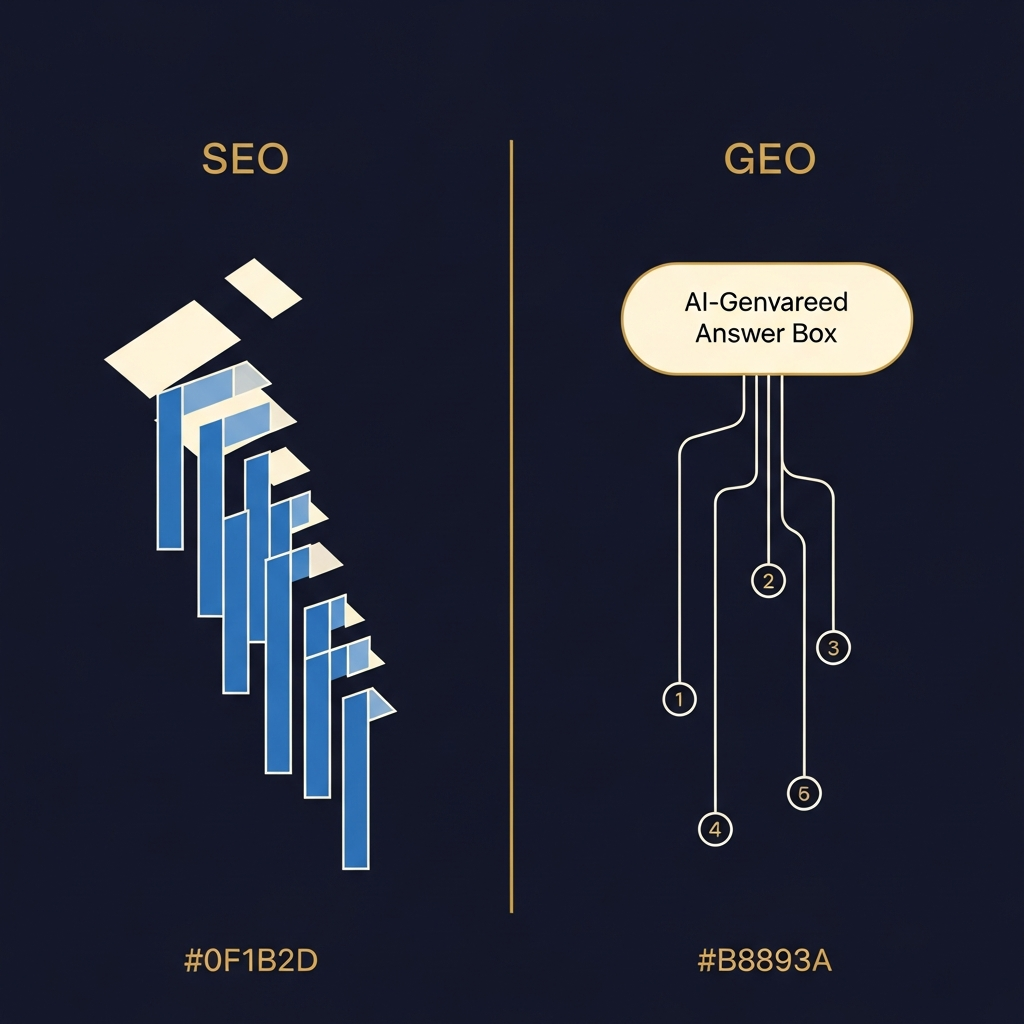
Traditional SEO optimized for one thing: ranking your URL in a list of blue links so a human would click. Generative engine optimization optimizes for something different: getting your content extracted, summarized, and attributed inside an AI-generated answer that the user reads without ever clicking through.
Three things changed at once to create this shift. Google launched AI Overviews and rolled them out site-wide. ChatGPT added browsing and started showing source citations in its answers. Perplexity built an entire search product around the citation model. Bing followed. Then Claude added search. Then Gemini.
Suddenly the user journey ended at the answer instead of at your site. The new question wasn’t “how do I rank in the results” — it was “how do I get cited in the answer.” That’s GEO.
GEO vs Traditional SEO — The Actual Differences
I keep seeing GEO described as “the new SEO” or “SEO 2.0.” Both framings are wrong. GEO is not a replacement for SEO. It’s an additional optimization layer that runs alongside SEO, with some shared signals and some completely new ones.
Here’s the side-by-side that actually matters:
| Dimension | Traditional SEO | Generative Engine Optimization |
|---|---|---|
| Goal | Rank a URL high in blue-link results | Be cited as a source in AI-generated answers |
| Primary surface | Search results page (SERP) | Generated answer box (AI Overviews, ChatGPT, Perplexity, Claude) |
| Success metric | Click-through rate, organic sessions | Citation rate, brand mentions in AI answers, qualified referrals |
| Anchor signals | Backlinks, page authority, on-page keyword targeting | Entity recognition, schema markup, topical depth, E-E-A-T |
| Content structure | Optimized for human scanning + Google ranking | Optimized for extraction + attribution |
| Question matching | Match the search query keyword | Answer the underlying question in 40–80 word blocks |
| Author signal | Helpful but secondary | Critical — AI engines weight identifiable expertise heavily |
| Refresh cadence | Quarterly to annually | Continuous — AI engines weight recency in citation selection |
| Failure mode | Page exists but doesn’t rank | Page ranks but doesn’t get cited |
About sixty percent of your existing SEO work translates. Keyword research still matters. On-page optimization still matters. Internal linking still matters. Site speed still matters. Schema still matters.
What changed is the addition of new requirements that didn’t exist three years ago — and the upgrading of old requirements that used to be optional. Author markup used to be nice-to-have. Now it’s a citation gate. FAQ schema used to be a featured-snippet play. Now it’s a primary citation surface for AI Overviews. Topical depth used to mean “write long articles.” Now it means “demonstrate expertise across an entire knowledge graph in a way the AI can detect.”
Honestly, the biggest practical difference is this: traditional SEO rewarded sites that gamed the ranking signal. GEO rewards sites that actually know what they’re talking about. That’s a meaningful shift in what kind of content wins.
GEO vs AEO vs AIO vs LLM SEO — Mapping the Vocabulary
The acronym debates are exhausting and I’ve been guilty of contributing to them. Let me settle the working definitions so the rest of this guide makes sense.
Generative Engine Optimization (GEO) is the umbrella term. It covers optimization for any AI engine that generates answers — Google AI Overviews, ChatGPT, Perplexity, Claude, Gemini, Copilot, and others as they emerge. This is the term that won, and the term I’ll use throughout this guide.
Answer Engine Optimization (AEO) was the earlier name, popular through 2023 and into 2024. It originally referred specifically to optimizing for “answer engines” — products like Perplexity that explicitly position themselves as alternatives to traditional search. Some practitioners still use AEO as a synonym for GEO. Functionally, they describe the same work.
AI Overview Optimization (AIO) is the narrowest term. It specifically refers to optimization for Google’s AI Overviews feature, not to the broader AI engine landscape. If you see AIO used as a synonym for GEO, the person using it is probably referring only to the Google surface.
LLM SEO is the most technical-sounding of the four terms and refers to optimizing content for large language models specifically. In practice, it covers the same work as GEO with slightly different emphasis — LLM SEO writers tend to focus more on tokenization patterns, prompt-completion behavior, and how content gets embedded into vector representations.
For practical purposes, all four terms describe the same body of work. I use GEO because it’s the term Google’s own documentation has started referencing, and because it’s the term that’s winning the search volume contest in this niche. If your competitor uses AEO or LLM SEO, they’re describing the same thing.
How AI Engines Actually Decide Who to Cite
This is where most of the confusion in this niche lives. Practitioners who came from traditional SEO assume citation selection works like ranking selection — backlinks, page authority, exact-match keywords. It doesn’t.
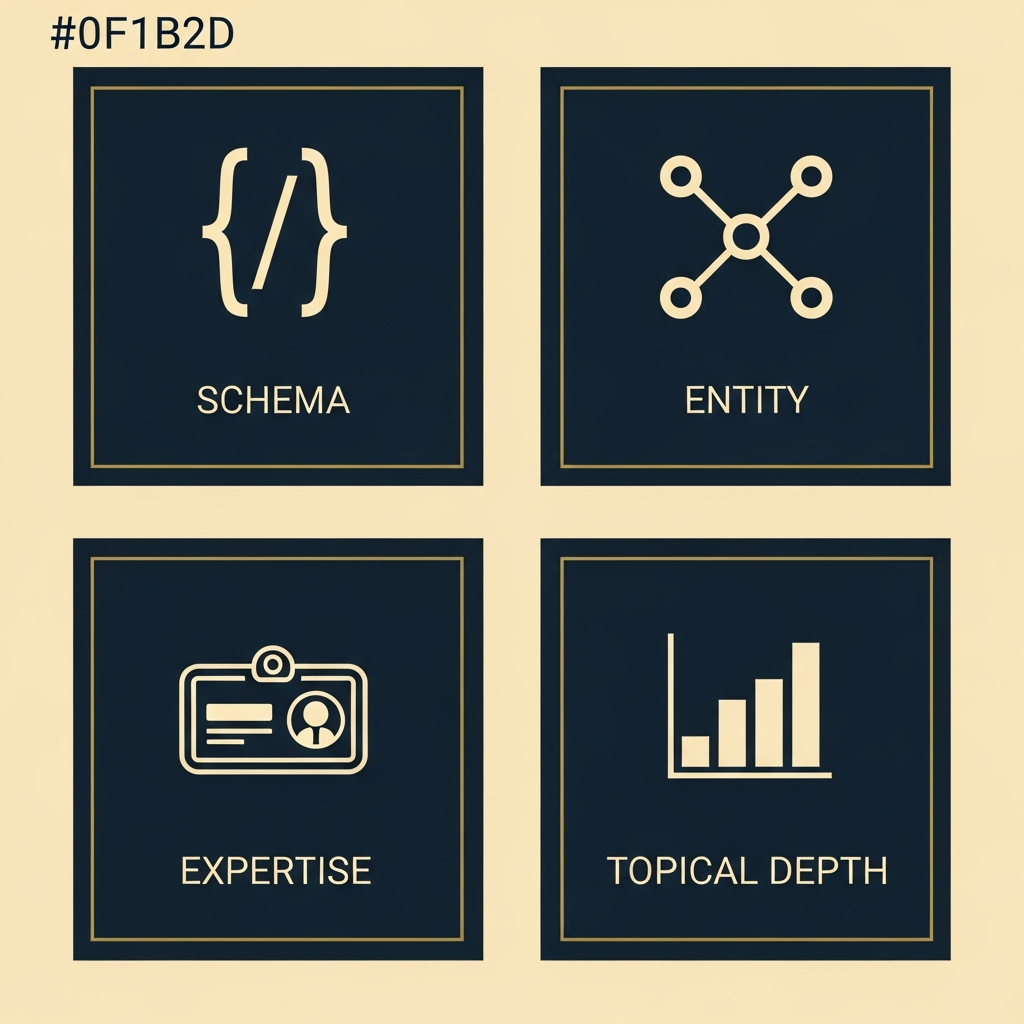
After eighteen months of testing across the four engines, I’ve identified four signal categories that consistently predict citation likelihood. I call them the SEE+ signals — Schema, Entity, Expertise, and one bonus signal I’ll explain at the end.
Signal 1: Schema markup. AI engines parse structured data before they read prose. A page with FAQPage schema, Article schema with full author markup, HowTo schema for step-by-step content, and BreadcrumbList schema for navigation context has a measurable citation advantage over a page with the same content but no schema. I’ve tested this on identical content across staging and production environments. Schema isn’t optional anymore — it’s the first thing the AI sees.
Signal 2: Entity recognition. AI engines maintain knowledge graphs of entities — people, organizations, concepts, locations, products. When you mention an entity in your content, the AI checks whether you’ve correctly identified it, whether you’ve linked it to other entities it’s related to, and whether your content adds new information about that entity. Pages that demonstrate accurate entity recognition get cited more often than pages that mention entities sloppily or generically. This is why Wikipedia ranks so well in AI citations — Wikipedia is an entity database in prose form.
Signal 3: Expertise signals. AI engines are explicitly trained to prefer sources that demonstrate first-hand experience, identifiable expertise, recognized authority, and trust signals. A page authored by “Admin” with no bio, no credentials, and no first-person experience will lose to a page authored by a named expert with a real background — even when the unauthored page has better keyword optimization. Author markup, About pages, bio pages, and the substance of the content itself all feed this signal. Google’s Search Quality Evaluator Guidelines devote significant space to exactly this dimension — it’s not a soft preference, it’s a scored evaluation criterion.
Signal 4: Topical depth. AI engines try to find sources that demonstrate comprehensive understanding of a topic, not just answers to a single query. A site with thirty pages covering every angle of a topic outranks a site with one excellent page on the same topic for AI citation purposes — because the AI infers that the deeper site actually knows the subject. This is why pillar-and-cluster content architecture matters so much for GEO. You’re not just building for human readers — you’re demonstrating topical authority to a machine that scans your whole site before deciding whether to cite a single page.
The bonus fifth signal is recency. AI engines weight freshness more heavily than traditional SEO does. A six-month-old page that hasn’t been updated will lose citations to a two-week-old page with the same content quality. This creates a continuous refresh requirement that traditional SEO didn’t have. Sites that “publish and forget” are losing visibility fast.
When I rebuilt the AI Search Audit order page in March 2026, I added FAQPage schema, Speakable markup, and a named-author byline in a single sitting. Within nineteen days, the page was being cited in Perplexity answers for “ai search visibility tool” queries — citations that hadn’t existed for the same content prior to the schema work. The recurring lesson from these tests: the schema layer is faster-acting than any other GEO signal.
How Each Major Engine Handles Citations Differently
The four engines aren’t identical. They use overlapping signals but weight them differently and behave differently in how they surface citations.
Google AI Overviews sit at the top of search results and are powered by Gemini. They lean heavily on traditional SEO signals — pages that already rank in the top ten are more likely to be sourced for the Overview. Schema is critical here, especially FAQPage and HowTo. Citations appear as small linked thumbnails. The AI Overview also pulls heavily from sites with strong topical authority on the query subject.
ChatGPT (with browsing enabled) uses a hybrid approach. For queries that match its training data well, it answers from training memory and attributes broadly. For queries that need real-time information, it browses, finds two to six sources, and cites them with linked numbered footnotes. ChatGPT weighs author identity heavily — a page with a clear named expert author gets cited more often than an anonymous page on the same topic.
Perplexity is the most aggressive citation engine. Every answer comes with three to ten numbered sources, and Perplexity explicitly tells the user to verify by clicking through. Perplexity weighs recency very heavily — sometimes citing a six-hour-old article over an authoritative two-year-old one. Pages with strong FAQPage schema get cited in Perplexity at rates I haven’t been able to match elsewhere.
Claude (with search enabled) is more conservative in its citation patterns. It tends to cite fewer sources per answer (often just two or three) but weighs source quality more heavily. Pages with strong E-E-A-T markers get cited disproportionately. Claude also tends to favor primary sources — research papers, government data, named-expert opinion pieces — over aggregator sites or news rewrites.
Gemini mirrors Google AI Overviews in most ways since they share underlying infrastructure, but Gemini-the-chatbot tends to be more conversational and less explicit about citations than AI Overviews are. The signals that work for one tend to work for the other.
A page that’s well-optimized for one engine usually performs decently across all four. A page that’s poorly optimized loses on all four at once. The signals correlate strongly enough that you can build a single GEO strategy rather than four separate ones.
Generative Engine Optimization Examples — What Actually Gets Cited
Let me walk through three patterns I see consistently get cited, and three patterns that consistently don’t.
Pattern that gets cited #1: The direct-answer block. A page that asks a clear question as an H2 heading, then answers it in 40–80 words of tight prose immediately below, gets pulled into AI Overviews and Perplexity citations at high rates. The format mimics the structure the AI itself uses, which makes extraction trivial. The header text matches the user’s query phrasing closely. The answer is short enough to lift cleanly.
Pattern that gets cited #2: The comparison table. Tables comparing two or more options on the same dimensions (X vs Y, with multiple rows) get cited heavily by Perplexity and ChatGPT for comparison queries. The structure tells the AI exactly what’s being compared and how, which makes the data trivial to extract. A well-structured comparison table can outperform thousands of words of prose on the same subject.
Pattern that gets cited #3: The first-person experiential anecdote. Content that includes specific first-person details — “In our experience, sites typically see…” or “When I tested this on…” — gets cited disproportionately by Claude and ChatGPT. The signal is that this content comes from someone who actually did the work, not someone who synthesized it from existing sources. AI engines are trained to detect and reward this signal.
Pattern that doesn’t get cited #1: The generic listicle. “10 best X” articles without distinctive analysis get ignored by AI citations almost entirely. The AI has thousands of identical articles to choose from and no reason to pick yours. Listicles that survive citation review are the ones with original criteria, named author perspective, and specific reasoning for each entry.
Pattern that doesn’t get cited #2: The wall of text. A page that buries its key insights in long flowing paragraphs without clear structural signals gets parsed but rarely cited. The AI can extract from anywhere, but it prefers content that signals what’s important through structure — headings, lists, tables, schema. Walls of unstructured prose are extraction-hostile.
Pattern that doesn’t get cited #3: The anonymous explainer. A page with no clear author, no bio, no first-person experience, and no E-E-A-T signals can have perfect keyword optimization and still get bypassed entirely. The AI sees no reason to trust this source over the next one. Author identity is a citation gate.
The SEE Framework — How to Audit Your Own Site for GEO
Most GEO audits I see online are either too generic to be useful or too technical to be actionable. I built a three-layer framework called SEE — Schema, Entity, Expertise — that I run on every site I audit. It’s the same framework that powers the AI Search Audit I deliver as a service.
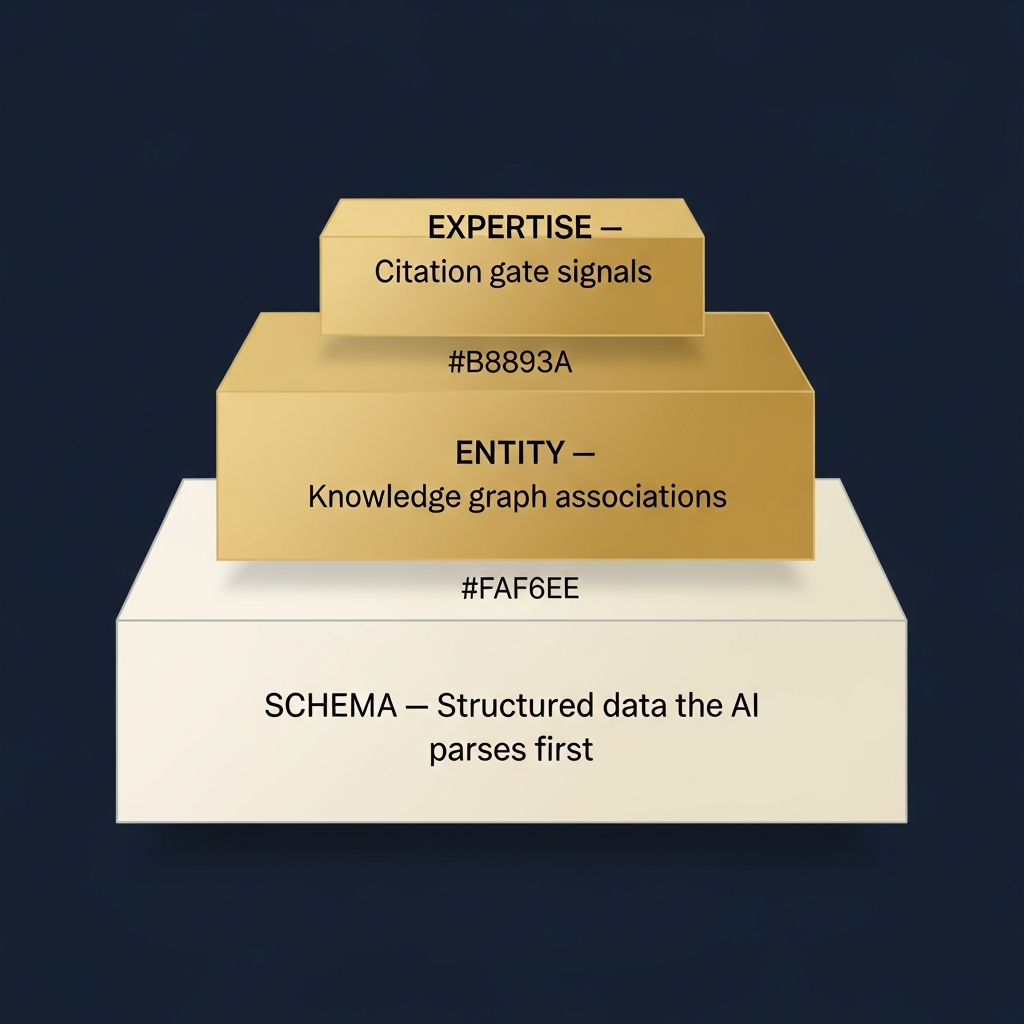
Layer 1: Schema
Inventory the structured data on every page that’s meant to be discoverable. At minimum, every public page should have:
- Article schema with author, datePublished, dateModified, and publisher fields populated
- Person schema for the author with hasCredential, knowsAbout, sameAs (linking to social profiles), and url fields populated
- Organization schema at the site level with logo, sameAs, and foundingDate
- FAQPage schema on any page that includes question-answer content
- HowTo schema on any page that includes step-by-step instructions
- BreadcrumbList schema on every non-homepage URL
- Speakable schema identifying the 2–4 most extractable sentences on the page (specifically for Google AI Overviews)
Test your schema using Google’s Rich Results Test. Fix every error, every warning, every “recommended” field that’s not populated. The threshold isn’t “valid” — it’s “complete.”
Layer 2: Entity
Map the entities your site is trying to be associated with. For Bryan Collins Online, the entities are “generative engine optimization,” “AI search audit,” “Astro authority site builder,” “SEO consulting.” For your site, they’re whatever your three to seven core topics are.
For each entity, check:
- Is the entity name used consistently across the site (same spelling, same capitalization)?
- Is the entity defined clearly somewhere on the site (typically in a pillar or hub page)?
- Are the entity’s related concepts linked from the entity definition?
- Does your About page connect you (the author) to these entities via knowsAbout in Person schema?
- Has the entity been claimed in your social profiles, GitHub, LinkedIn (linked via sameAs)?
The goal is for the AI’s knowledge graph to associate your name, your business, and your topics in a single connected cluster.
Layer 3: Expertise
For every page that’s meant to rank or get cited, audit the expertise signals:
- Named author with bio, photo, and credentials
- Author byline links to a real About page
- Content includes first-person experiential detail (“I tested this,” “we found that,” “in our experience”)
- Specific examples, not generic ones
- Pricing or numerical specificity where applicable
- Citations to primary sources, not aggregators
- Last-updated date visible to readers
- Comments or contact mechanism that demonstrates the author is reachable
A page that passes all three SEE layers is highly citable. A page that fails any of them is leaving citations on the table.
How to Implement Generative Engine Optimization (Step-by-Step)
Here’s the practical sequence I follow when implementing GEO on a new site or rebuilding GEO on an existing one.
Step 1: Audit the current state. Time required: 60–90 minutes per major page. Run the SEE Framework against your top ten pages by traffic. Identify which signal layers are weakest. Document specifically what’s missing — not just “schema is weak” but “FAQPage schema absent on /pricing, Article schema missing dateModified on /blog/*.”
Step 2: Fix the schema layer first. Time required: 2–4 hours for a typical site. Implement complete Article, Person, Organization, FAQPage, HowTo, and BreadcrumbList schema across all relevant pages. Validate everything in Google’s Rich Results Test. This is the lowest-effort, highest-leverage GEO move you can make.
Step 3: Build the entity layer. Time required: 4–8 hours over two weeks. Create a clear About page that establishes who you are and what topics you know. Link the About page from every relevant content page. Ensure your author name is consistent across the site. Add knowsAbout fields to Person schema. Claim and link your social profiles.
Step 4: Upgrade expertise signals. Time required: ongoing — typically 30–60 minutes per page. Add named author bylines to every content page. Add 1–3 first-person experiential sentences to each page. Add specific examples, numbers, or anecdotes where you currently have generic claims.
Step 5: Build topical depth. Time required: 90-day content sprint. Identify your three to five core topics. For each topic, publish a pillar page plus eight to twelve supporting articles within ninety days. Internally link the supporting articles to the pillar and to each other.
Step 6: Maintain freshness. Time required: 15–30 minutes per page per quarter. Update the dateModified field on Article schema when you make substantive changes. Refresh statistics, links, and screenshots quarterly. Add new sections to pillar pages as the topic evolves.
This sequence works because each step compounds the value of the previous one. Schema with no entity layer is wasted markup. Entity recognition with no expertise signal still won’t get cited. Topical depth on a site with no schema can’t be parsed efficiently. Do them in order.
Generative Engine Optimization Tools and Software
The GEO tool market is still early. As of May 2026, there are roughly four categories of tools, none of which fully solve the problem.
Schema generators and validators. Schema.org’s own validator, Google’s Rich Results Test, Schema Markup Generator (technicalseo.com), and similar tools. Free, but they generate isolated schema blocks rather than coordinated site-wide schema strategies.
AI visibility trackers. A handful of tools that monitor whether your site appears in AI Overviews, ChatGPT citations, or Perplexity answers for tracked queries. Profound AI, Otterly, Athena, and a few others. These are useful but expensive — typical pricing starts at $99–499/month — and the data quality varies. Most of them only check Google AI Overviews and Perplexity, not Claude or ChatGPT.
Audit and recommendation tools. A smaller category — tools that scan your site, identify GEO gaps, and recommend fixes. These are emerging fast but mostly run as monthly subscriptions ($199–999/month) that include monitoring, not one-time audits.
Done-for-you audit services. Consultants and small agencies that run manual GEO audits and deliver written reports with specific recommendations. Pricing ranges from $49 (my own AI Search Audit) to $5,000+ for enterprise-grade reports from larger consultancies.
For most small and mid-sized sites, the right starting point is a one-time manual audit followed by a quarterly self-check using the SEE Framework. Monthly tracking subscriptions are useful once you’ve already implemented the fundamentals and need to monitor whether your work is moving the needle.
Which AI Search Optimization Tool Is Most Intuitive?
Honestly, none of them have nailed the user experience yet. The tracking tools are dense dashboards built for SEO professionals. The schema generators are technical and disconnected from each other. The recommendation tools tend to flag issues without explaining why they matter or how to prioritize them.
If I had to pick the most intuitive option in 2026, I’d recommend starting with Google’s free Rich Results Test for schema validation, plus a one-time manual audit for the full SEE Framework. Most of the paid tools assume you already know what to do — they’re monitoring tools, not learning tools. For someone new to GEO, a written audit with specific recommendations beats a dashboard you don’t yet know how to read.
Best AI Search Optimization Platform for Beginners
If you’re new to this work and want a single starting platform, I’d actually recommend not starting with a platform. Start with three free tools — Google’s Rich Results Test, Google Search Console, and the AI engines themselves (run test queries about your topic and see who gets cited). That gives you the same diagnostic capability as most paid platforms, without the subscription cost.
Once you’ve fixed the obvious issues, then evaluate whether ongoing monitoring is worth the spend.
Frequently Asked Questions
What does GEO mean in SEO?
GEO stands for Generative Engine Optimization. It’s the practice of structuring your website so AI search engines like ChatGPT, Perplexity, Claude, and Google AI Overviews cite you as a source when they generate answers. It overlaps with traditional SEO by about sixty percent but adds new requirements around schema, entity recognition, expertise signals, and topical depth.
How long does generative engine optimization take to work?
Schema-layer fixes show up in AI citation patterns within two to six weeks. Entity layer work takes one to three months to register in AI knowledge graphs. Topical depth — the highest-leverage layer — takes three to nine months to compound. Sites that implement GEO consistently over twelve months see citation rates grow predictably across all four major engines.
Can I do GEO myself, or do I need an agency?
Most of the schema and entity layer work is well within reach for a technically capable site owner. The hardest part is auditing your current state objectively — most site owners struggle to identify their own gaps. A one-time audit from someone outside your site is usually more valuable than an ongoing agency relationship, especially in the first year.
Is GEO replacing traditional SEO?
No. GEO is a layer on top of SEO. Sixty percent of the work overlaps — keyword research, on-page optimization, internal linking, and site speed still matter. What changes is the addition of new signal categories (schema completeness, entity recognition, expertise signals, topical depth) that didn’t matter as much in the blue-link era. Sites that abandon SEO fundamentals to chase GEO trends lose on both dimensions.
Do I need a generative engine optimization agency?
For most sites under $10 million in revenue, no. A one-time audit plus quarterly self-checks using a framework like SEE is usually sufficient. Agencies become worth the cost when you’re operating at scale — multiple sites, hundreds of pages, or competitive verticals where citation share directly drives revenue.
What’s the best generative engine optimization course?
The honest answer is that the field is moving too fast for courses to keep up. Most paid GEO courses I’ve reviewed are six to twelve months behind current AI engine behavior. Free resources — including this guide, your own testing across the AI engines, and active Twitter/LinkedIn discussion threads — tend to be more current than paid courses.
How do I measure GEO success?
Three metrics matter: citation rate (how often your site is cited in AI-generated answers for tracked queries), referral traffic from AI engines (visible in Google Analytics under the source/medium report), and brand-mention volume in AI answers (track this manually by running query checks across the four engines monthly). Traditional ranking metrics matter less because the user journey often ends in the AI answer, not on your page.
Does my schema need to change for AI search?
Yes, but mostly through addition rather than replacement. Most sites have basic Article and Organization schema. For GEO, you need to add FAQPage where applicable, HowTo where applicable, BreadcrumbList on every page, and richer Person schema for authors. Speakable schema is new and specifically targets Google AI Overviews. The existing schema you have probably stays — you’re augmenting, not rebuilding.
Is generative engine optimization different from LLM SEO?
In practice, no. The two terms describe the same body of work with slightly different emphasis. LLM SEO writers tend to focus more on technical details like tokenization and embedding patterns. GEO writers tend to focus more on practical signal categories like schema and expertise. The recommendations are largely identical.
Next Steps
If you’ve read this far, here’s what to do this week:
-
Run a test query about your topic in all four AI engines (ChatGPT, Perplexity, Claude, Google AI Overviews). See who gets cited. If it’s not you, note who it is and what their content structure looks like.
-
Run Google’s Rich Results Test on your three most important pages. Note every missing or incomplete schema type.
-
Open your About page and assess: does it clearly identify you, your expertise, and your topics? Would an AI engine know what to associate your name with?
If you want me to do the full SEE Framework audit for you — schema layer, entity layer, expertise layer, with specific recommendations and the actual code or text to add — that’s the AI Search Audit I deliver as a service. It’s $49, takes about a week to receive, and you get a written report with everything ranked by impact.
If you’d rather work through this yourself, bookmark this guide. The framework is the work. The audit is just acceleration.
If you want updates as GEO behavior changes across the engines, I send roughly one analysis per week at Become a Writer Today covering what’s shifting in AI search and authority site building.
If you want to go deeper on specific aspects of GEO, three follow-on pieces from this cluster:
- GEO vs SEO: What’s Actually Different in 2026 — the 60% overlap, the 40% that’s new, and a 90-day transition plan
- AEO vs GEO: Which Acronym Actually Matters? — settles the vocabulary debate so you can focus on the work
- Best AI SEO Tools in 2026: An Honest Review — what’s actually worth paying for across the GEO tool stack

Bryan Collins runs CRST Web and bryancollinsonline.com. He's worked in digital infrastructure for thirty years and is the author of "Why Your Website Isn't Ringing: The Send Click Convert System for Local Businesses" (Amazon, 2025). He builds GEO-optimized authority sites using Astro and Tailwind CSS, delivers AI Search Audits for small and mid-sized businesses, and runs the Tradesman Stack SaaS at newtradeleads.com — all built on the GEO principles described in this guide.
Last updated: May 23, 2026. This page is refreshed quarterly as AI engine behavior evolves.